How not to become a statistic
Why do mergers succeed or fail? With the success rate running somewhere between 10% and 30%, depending on the study you read, there’s a huge scope for missed expectations and underperformance. How can you raise the odds? In this short read, we look at what we’ve been seeing in the field recently, our observations on where the fine line between success and failure lies and remedial steps to make sure everything (and everyone) comes together in the best way possible.So why do mergers succeed or fail?
You’ll recognise the first phase. It often focuses on structure, systems and legal mechanics, all of which are essential, as are governance and financial synergies. But when 83% of practitioners involved with failed deals point the finger at poor integration, it’s clear that best laid plans on paper don’t always translate into success in real life. That’s because mergers and acquisitions require a people-centred approach to work. If these deeper challenges have been overlooked, they’ll only emerge later on down the line. Unfortunately, this is usually when the organisations have been formally combined – but not yet aligned in terms of how people lead, work, grow and make decisions. At this point, getting the balance right becomes a critical issue.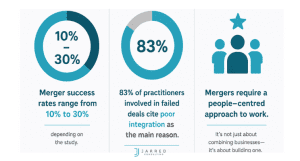
Mind the gap
So everything can be in place: from reporting lines to migration systems and new organisational charts, but a sense of true cohesion is conspicuous by its absence. In our experience, the most notable fragmentations exist in:- Leadership expectations.
- Decision-making habits.
- Values and behaviours.
- Performance standards.
- Reward logic.
- Recruitment and onboarding.
- Development and progression.
- The broader employee experience.
Why does the people side of things get overlooked?
Simply put, its importance is often underestimated for several reasons:- There’s an assumption that culture and people processes will naturally settle on their own over time.
- It’s considered an HR thing, rather than a central part of the commercial integration agenda.
- Organisations underestimate how strongly legacy identifies behaviours after a deal completes.
What great looks like
True cohesion from all angles involves elevating the human side of the story. It means making intentional choices about:- How leaders should work together and communicate.
- The behaviours that are expected and rewarded.
- Processes that stay, and where new ones need to be adopted.
- The kind of organisation people are being asked to join.
Leadership holds it all together
Mixed messages from the top create confusion below, which is why the leadership team should be tight – living, breathing and modelling the newly established values and goals. A senior team that’s clear on priorities, tone, behaviours and trade-offs secures trust and certainty within the organisation. That’s why successful integrations often require leadership support as well as process redesign.The five key elements to beat the odds
Success isn’t just about harmonisation, it’s about coherence across the new, evolving systems and the people adopting them. A successful organisation will make sure that:- People and talent processes are aligned.
- New values and behaviours are defined, understood and adopted.
- Compelling people propositions and EVP are intentionally created.
- Leadership is pulling in one direction.
- Work culture is connected to real implementation.